16 June 2006

How to Photograph God: Kabbalah through a Creative Lens

I am working on a book based upon projects with my students at Emuna College in Jerusalem and Ariel University that will be titled: How to Photograph God: Kabbalah through a Creative Lens 

(The book was published in 2015 with the title: PHOTOGRAPH GOD: CREATING A SPIRITUAL BLOG OF YOUR LIFE.) 
Below is an excerpt from the introduction to the book:
"Focus your camera lens on God and you will see God looking back at you. Seeing God is seeing divine light reflected from every facet of your life. The ancient wisdom of kabbalah will help you recognize that you have been looking at God all the time but missed the action.

You only see light. You have never seen your mother, father, spouse, or children. You only have seen the light reflected from them. You only see light passing through your eye’s lens, stimulating the rods and cones in your retina, and transmitting the forms and colors of those you love to your brain. Just as you enjoy seeing your loved ones from the light they reflect, you can find joy seeing divine light reflected from every place you look. This book teaches how to see the spectrum of divine light through your camera lens."


Photographing Tiferet/Beauty
My student, Roni Levi, photographed the birthing of a calf, an awesome event expressing tiferet/beauty as the vital balance between the farmer's hesed/compassion and gevurah/strength in helping bring new life into the world.

Seeing God through a ViewfinderThe project that I assigned my students at the College of Judea and Samaria and Emunah College of the Arts in Israel was to photograph God – to document processes revealing six divine attributes in their everyday life.
Hesed: Compassion / Largess / Loving All
Gevurah: Strength / Judgment / Setting Limits
Tiferet: Beauty / Aesthetic Balance / Inner Elegance
Netzakh: Success / Orchestration / Eternity
Hod: Splendor / Gracefulness / Magnificence
Yesod: Integration / Foundation of Everything/ Gateway to Action

Seeing God is Getting in Touch with Reality
Rabbi David Aaron wrote an insightful book, Seeing God, (New York: Berkley Books, 2001), using kabbalistic insights to illuminate how we can see divine light all around us. He shares my discomfort using the word “God,” a Germanic word conjuring up images of some all-powerful being zapping us if we step out of line. He calls God Hashem, literally “The Name” in Hebrew, the name of the nameless One encompassing all of reality and beyond. He writes:

Hashem does not exist in reality – Hashem is reality. And we do not exist alongside Hashem, we exist within Hashem, within the reality that is Hashem. Hashem is the place. Indeed, Hashem is the all-embracing context for everything. So there can’t be you and God standing side by side in reality. There is only one reality that is Hashem, and you exist in Hashem…. Everything is in Hashem, Hashem is in everything, but Hashem is beyond everything…. Seeing God is all about getting in touch with reality.
Like the spectral colors that make up white light, we can see the spectrum of divine light in our everyday world as the attributes of compassion, strength, beauty, success, splendor, and integration.

To see more go to:
Photograph God BlogGo to www.photographgod.com

13 June 2006

Man Plans, God Laughs

2009 / Wonderful Book / No School

The March 2006 proposal for the creation of a new School of Art and Multimedia at Netanya Academic College was rejected by Israel's Council for Higher Education. The proposal grew into my 2008 book Educating Artists for the Future: Learning at the Intersections of Art, Science, Technology, and Culture.

This is my letter to The Jerusalem Post, 31 August 2009

Sir – Lack of funds is not the only reason for Israel’s brain drain. It is lack of vision and ineptitude. The editorial “Save our scientists” (August 27) states that Israel’s official policy is “to combat the brain drain by drawing to Israel both some of those Israelis who have left and also new immigrants.” Israel’s Council for Higher Education defies that policy even when no funds are involved.

A proposal for a School of Art and Multimedia that recruited faculty from among Israelis working abroad and potential olim was rejected. It was proposed by Netanya Academic College, an accredited private institution of higher education that requested no funding from the Israeli government for this new school.

The curriculum for this new school was designed by an expert in new media art living in Israel (a former art professor at Columbia University and research fellow at MIT’s Center for Advanced Visual Studies) in cooperation with an International Advisory Board of the world’s most innovative thinkers in higher education in the arts. The recommendations of these top professors were developed into a book ‘Educating Artists for the Future: Learning at the Intersections of Art, Science, Technology, and Culture’ published by Intellect Books/University of Chicago Press. The unprecedented inclusion of a highly acclaimed book created especially as an integral part of a proposal for an academic program was ignored.

The Council for Higher Education committee to approve a school of art and multimedia had no representatives of the arts. It was made up of an architect, graphic designer, and industrial designer. It is as if a committee of a pharmacist, dentist, and veterinarian was formed to approve a proposal for a new medical school.

It is not just lack of funds that is crippling Israel’s higher education. It is the professional incompetence of Israel’s educational bureaucracy that drives 3,000 top-notch Israeli scientists to work abroad.

Menahem Alexenberg
Petah Tikva


Netanya Academic College
School of Art and Multimedia
Learning at the
Intersections of Art, Science, Technology, and Culture

I am negotiating with Israel’s Council of Higher Education for approval to establish a new fully accredited School of Art and Multimedia at Netanya College. I will be Dean of the School when it opens next year.

The New School
The School of Art and Multimedia will offer B.A. and M.F.A. programs in which students creatively redefine art at the interdisciplinary interface where new technologies and scientific inquiry shape cultural values of a Jewish state in an era of globalization. The program will couple theoretical studies with studio practice using new media to make artworks that create a lively dialogue between artist and society. It will prepare artists and designers to contribute imaginatively to Israeli and global culture and to develop innovative uses of digital imaging and multimedia in a wide range of fields.

The College
Netanya College was founded in 1995 as the university of the Sharon region between Tel Aviv and Haifa and is Israel’s fastest growing institution of higher education. It offers degrees in computer science and mathematics, communications, behavioral sciences, law, business administration and banking to its 4,000 students. The College is creating new degree programs in art and multimedia design, industrial engineering and management, and Middle Eastern studies. Its Strategic Dialogue Center, co-chaired by former president of USSR, Mikhail Gorbachev, and Prince Hassan Bin Tallal of Jordan, develops practical applications of integrated academic techniques in dealing with conflict-ridden areas of the globe.

Educational Program
The conceptual basis for the Netanya program is based upon an analysis of BA, BFA, MA, and MFA programs in American art colleges and university art departments that have a range of cognate titles: digital art, digital media, art and technology, computer art, conceptual information arts, media arts, new media, new genres, electronic art, interactive media, intermedia, multimedia design, electronic imaging and digital multimedia, interdisciplinary computing and the arts, arts computation engineering, interactive telecommunications, science technology art, and others.

I presented an educational model based upon this analysis at the SIGGRAPH 2005 conference on computer graphics and interactive media in Los Angeles. I am developing it further based upon the concepts of the world's most prominent educators in new media arts who have contributed to my 2008 book, Educating Artists for the Future: Learning at the Intersections of Art, Science, Technology, and Culture, being published by Intellect Books/University of Chicago Press.

Creative Learning
The educational model for the new school integrates this research with a structure of creative learning derived from Jewish thought. It explores interrelationships between five realms leading from intentions, thoughts, and feelings to action:

1. Precognitive realm of consciousness / spirituality / intention.
2. Cognitive realm of insight / conceptualization / inquiry.
3. Affective realm of emotions / aesthetic experience / artistic expression.
4. Space-time realm of action with materials / technologies / media.
5. Space-time realm of action in local community / global culture / business and industry.

22 May 2006

Writing to Ahmadinejad based on Islam


Letter to the Editor
The Jerusalem Post
May 22, 2006

President Ahmadinejad:

Your aim to wipe Israel off the map defies the values of Islam expressed in the Holy Koran and through Islamic art.

In Islamic art, a uniform geometric pattern is purposely disrupted by the introduction of a counter-pattern to demonstrate that human creation is less than perfect. Based upon the belief that only Allah creates perfection, rug weavers from Islamic lands intentionally weave a small patch of dissimilar pattern to break the symmetry of their rugs. The Islamic artisan does not want to be perceived as competing with the perfection of Allah.

Perhaps you see a continuous pattern like a beautiful Islamic rug running from Morocco on the Atlantic Ocean to the eastern borders of Iran. Shift your perception to see Israel, not as a blemish on the great Islamic rug, but as a small counter-pattern needed to realize Islamic values.

The ingathering of the Jewish People into its historic homeland in the midst of the Islamic world is the fulfillment of Mohammed’s prophecy in the Koran (Sura 17:104): “And we said to the Children of Israel, ‘scatter and live all over the world…and when the end of the world is near we will gather you again into the Promised Land.”

Switch your viewpoint to recognize the sovereign right of the Jews over the Land of Israel as the will of Allah as expressed in the Koran (Sura 5:20-21): “Remember when Moses said to his people: ‘O my people, call in remembrance the favor of God unto you, when he produced prophets among you, made you kings, and gave to you what He had not given to any other among the people. O my people, enter the Holy Land which God has assigned unto you.’”

As a devout Muslim, you should recognize the State of Israel as a blessing expressing Allah’s will.

Prof. Menahem Alexenberg
College of Judea and Samaria
Ariel

07 May 2006

Kabbalah and Biofeedback Art


Inside/Outside: P'nim/Panim at MIT

Biofeedback Imaging System
The dynamics of my creative process in making a biofeedback imaging system as an interactive artwork at MIT's Center for Advanced Visual Studies can be elegantly described using an Jewish schematic system called kabbalah. Kabbalah explores how inspiration is drawn down into our everyday world in ten stages called sephirot (sephirah in singular) that are derived from biblical passages describing both the artist and God as creators of worlds (Exodus 35:31 and Chronicles 1:29).

Flash of Insight
The first stage in the creative process is the sephirah, Crown – faith that one can create, anticipation that the creative process is pleasurable, and intention to create. Without this self-confidence, hope for gratification, and will to create, the creative process has no beginning. Crown sets the stage for the sephirah of Wisdom that requires a selfless state, nullification of the ego that opens gateways to supraconscious and subconscious realms. When active seeking ceases, when consciously preoccupied with unrelated activities, when we least expect it, the germ of the creative idea bursts into our consciousness. This sudden flash of insight is what the kabbalah calls Wisdom. It is the transition from nothingness to being, from potential to the first moment of existence. In biblical words, “Wisdom shall be found in nothingness” (Job 28:12).

From Wisdom to Understanding
In synagogue on the Sabbath day, I was absorbed in the rhythm of the chanting of words from the Torah scroll following them with my eyes. I was far removed from my studio/laboratory at MIT when I suddenly realized that the word for face panim and for inside p’nim are written with the same Hebrew letters. I sensed that I needed to create portraits in which dialogue between the outside face and inside feelings become integrally one. This insight is called the sephirah Wisdom. When I told my son what had just dawned on me, my mind left the sephirah of Wisdom for the sephirah of Understanding. The shapeless idea that ignited the process began to take form in Understanding.

Largess and Restraint
The first three sephirot represent the artist’s intention to create and the cognitive dyad in which a flash of insight begins to crystallize into a viable idea. The fourth sephirah, Compassion, represents largess, the stage in the creative process that is open to all possibilities, myriad attractive options that I would love to do. Compassion is counterbalanced by the fifth sephirah of Strength, restraint, the power to set limits, to make judgments, to have the discipline to choose between myriad options. It demands that I make hard choices about which paths to take and which options to abandon.

Beautiful Balance
I thought of a multitude of artistic options opened to me for creating artworks that reveal interplay between inner consciousness and outer face. As an MIT artist with access to electronic technologies, my mind gravitated to creating digital self-generated portraits in which internal mind/body processes and one’s facial countenance engage in vital dialogue. As I felt satisfaction with my choice, I departed from the sephirah of Strength to the next stage, the sixth sephirah, Beauty. This sephirah represents a beautiful balance between the counter forces of largess and restraint. It is the feeling of harmony between all my possible options and the choices I had made. The sephirah of Beauty is the aesthetic core of the creative process in which harmonious integration of openness and closure is experienced as loveliness, splendor, and truth.

Orchestrating Dry Pixels and Wet Biomolecules
The seventh sephirah, Success, is the feeling of being victorious in the quest for significance. I felt that I had the power to overcome any obstacles that may stand in the way of realizing my artwork. The Hebrew word for this sephirah, netzakh, can also mean “to conduct” or “orchestrate” as in the word that begins many of the Psalms. I had the confidence that I could orchestrate all the aspects of creating a moist media artwork that would forge a vital dialogue between dry pixels and wet biomolecules, between cyberspace and real space, and between human consciousness and digital imagery. The eighth sephirah, Gracefulness, is the glorious feeling that the final shaping of the idea is going so smoothly that it seems as effortless as the movements of a graceful dancer. The sephirah of Success is an active self-confidence in contrast with the sephirah of Gracefulness, a passive confidence that all is going as it should.

Nobel Realization
The ninth sephirah, Foundation, is the sensuous bonding of Success and Gracefulness in a union that leads to the birth of the fully formed idea. It funnels the integrated flow of intention, thought, and emotion of the previous eight sephirot into the world of physical action, into the tenth sephirah of Kingdom, the noble realization of my concepts and feelings in the kingdom of time and space. It is my making the artwork.

Inside/Outside: P'nim/Panim
I constructed a console in which a participant seated in front of a monitor places her finger in a plethysmograph, which measures internal body states by monitoring blood flow, while under the gaze of a video camera. Digitized information about her internal mind/body processes triggers changes in the image of herself that she sees on the monitor. She sees her face changing color, stretching, elongating, extending, rotating, or replicating in response to her feelings about seeing herself changing. My artwork, Inside/Outside:P'nim/Panim, created a flowing digital feedback loop in which p'nim effects changes in panim and panim, in turn, effects changes in p'nim.

06 May 2006

Cyberangels: Aesthetic Peace Plan for the Middle East


Exhibition at Robert Guttmann Gallery of the Jewish Museum in Prague
www.jewishmuseum.cz/en/acyberangels.htm

Artistic Solution to Aesthetic Problem
The lack of peace in the Middle East can be seen as an aesthetic problem that requires an artistic solution. It calls for a shift in perception that can be derived from Islamic art and thought.

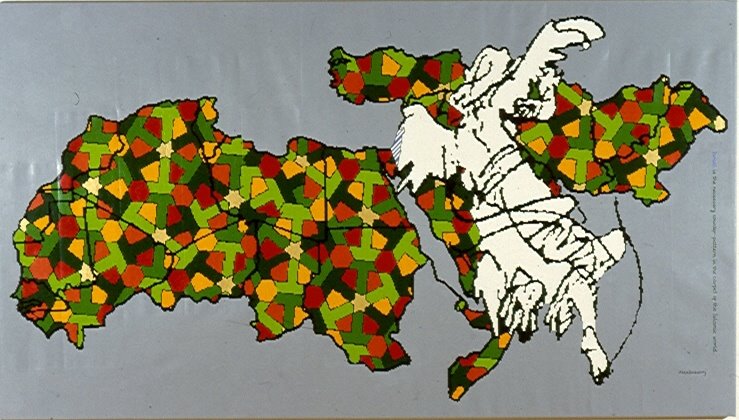
In my Cyberangels: Aesthetic Peace Plan for the Middle East exhibition, human creativity at its best in both Islamic and European cultures encounter each other. The beautiful patterns of Islamic art meet Rembrandt’s angels* in an aesthetic peace plan. The exhibition at the Robert Guttmann Gallery of the Jewish Museum in Prague juxtaposed my digital and systems artworks with authentic carpets from Islamic lands.

Perceptual Shift
The exhibition invites a perceptual shift through which Muslims see the State of Israel as a blessing expressing Allah’s will and Christians see it as the Divine fulfillment of the biblical promise of the Land of Israel to the Jewish people. Digitized Rembrandt angels* emerging from Islamic geometries are electronic age messengers drawing out the beauty in European and Islamic cultures rather than the ugly anti-Semitism that plagues them.

Art as Mirror of Culture
Historian of Islamic art, Elisabeth Siddiqui, writes in the Arabic journal Al-Madrashah Al-Ula that art is the mirror of a culture and its worldview. She emphasizes that there is no case to which this statement more directly applies than to the art of the Islamic world. “Not only does its art reflect its cultural values, but even more importantly, the way in which its adherents, the Muslims, view the spiritual realm, the universe, life, and the relationships of the parts to the whole.”

Disruption of Pattern
The repetitive geometric patterns in Islamic art teach Arabs to see their world as a continuous uninterrupted pattern that extends across North Africa and the Middle East. Unfortunately, they see Israel as a blemish that disrupts the pattern. From this perspective, Israel is viewed as an alien presence that they have continually tried to annihilate through war, terrorism, and political action. Palestinian Authority television labels Israel as a “cancer in the body of the Arab nation.” Its emblems, publications, schoolbooks, and web sites show the map of Israel labeled Palestine. Israel does not exist. The leaders of Hamas and Iran call for Israel to be "wiped off the map." Former Iranian president Rafsanjani expressed his longing for a day when an Islamic nuclear weapon could remove the “extraneous matter” called Israel from the midst of the Islamic world.

The major obstacle to peace between Jews and Arabs is the Islamic world’s rejection of Israel as a Jewish state in its midst. After more than a half century of independence, the State of Israel still does not exist on maps produced in Islamic countries. All road maps to peace in the Middle East will come to a dead end until the sovereign State of Israel is included in Arab maps.

Necessary Counter-Pattern
Fortunately, the perceptual shift needed to lead to genuine peace can be found in Islamic art and thought. In Islamic art, a uniform geometric pattern is purposely disrupted by the introduction of a counter-pattern that demonstrates human creation as less than perfect. Based upon the belief that only Allah creates perfection, rug weavers from Islamic lands intentionally weave a small patch of dissimilar pattern to break the symmetry of their rugs. Sheikh Abdul Hadi Palazzi, Imam of the Italian Muslim community who holds a Ph.D. in Islamic Sciences by decree of the Saudi Grand Mufti, proposes that the idea of underlying the Divine infinitude and the human fallacy by including some voluntary counter-pattern in works of art is common in Islamic art, and extends to tapestry, painting, music, architecture, etc. The Islamic artisan does not want to be perceived as competing with the perfection of Allah.

In “Islamic Textile Art: Anomalies in Kilims,” Muhammad Thompson and Nasima Begum write that the weavers of Moroccan kilim rugs, “devout Muslim women, would not be so arrogant as to even attempt a ‘perfect kilim’ since such perfection belonged only to Allah. Consequently, they would deliberately break the kilim’s patterning as a mark of their humility.”

Patterns of Life
Indeed, breaking symmetrical patterns characterizes life itself. All living organisms exhibit the principle expressed by the renowned biologist Paul Weiss as “order in the gross with freedom of excursion in details.” Every grape leaf, for example, is a unique variation of a general pattern. No two grape leaves on the same vine are congruent. Although a whole leaf gives the overall appearance of symmetry, a closer look at the details reveals a different venation pattern in each half of the leaf.

Islamic World Needs Israel to Realize its Values
Peace can be achieved when the Islamic world recognizes that they need Israel to realize their own religious values. Israel provides the break in the contiguous Islamic world extending from Morocco to Pakistan. Accepting the Jewish State as the necessary counter-pattern demonstrates humility and abrogates arrogance before Allah and honors the diversity evident in all of God’s creations. The ingathering of the Jewish people into its historic homeland in the midst of the Islamic world is the fulfillment of Mohammed’s prophecy in the Koran (Sura 17:104): “And we said to the Children of Israel, ‘scatter and live all over the world…and when the end of the world is near we will gather you again into the Promised Land.”

The State of Israel needs to be drawn on Islamic maps as a small break in the continuous pattern running from the Atlantic Ocean to the borders of India. If the contiguous Islamic world were the size of a football field, Israel would be smaller than a football placed in the middle of the field.

Land of Israel Deeded to the Children of Israel
Sheikh Palazzi quotes from the Koran, Sura 5:20-21, to support the Arab world’s need to switch their viewpoint to recognize the sovereign right of the Jews over the Land of Israel as the will of Allah: “Remember when Moses said to his people: ‘O my people, call in remembrance the favor of God unto you, when he produced prophets among you, made you kings, and gave to you what He had not given to any other among the people. O my people, enter the Holy Land which God has assigned unto you, and then turn not back ignominiously, for then will ye be overthrown, to your own ruin.’”

According to the Imam, Islam’s holiest book confirms what every Jew and Christian who honors the Bible knows: The Land of Israel was divinely deeded to the Children of Israel. The Jews are the indigenous people of the Land of Israel who have continuously lived there for more three millennia despite the conquests of numerous imperialist empires. Jews are from Judea. Arabs are from Arabia. The Arabs are blessed with 22 other countries.

Paradigm Shift
A paradigm shift can transform the perception of Israel as a blemish to seeing it as a tiny golden seed from which a lush green Islamic tree has germinated and spread its roots and branches across North Africa and the Middle East.

Professor Khaleed Mohammed, expert in Islamic law, explains: “As a Muslim, when I read 5:21 and 17:104 in the Quran, I can only say that I support that there must be an Israel. The Quran adumbrates the fight against tyranny and oppression, using the Children of Israel as an example, indeed as the prime example.” Tashibih Sayyed, Editor-in-Chief of Muslim World Today writes: “I consider the creation of the Jewish State as a blessing for the Muslims. Israel has provided us an opportunity to show the world the Jewish state of mind in action, a mind that yearns to be free…. The Jewish traditions and culture of pluralism, debate, acceptance of dissension and difference of opinion have manifest themselves in the shape of the State of Israel to present the oppressed Muslim world with a paradigm to emulate.”

A Fresh Metaphor for Peace
Peace will come from a fresh metaphor in which the Arabs see Israel’s existence as Allah’s will. A shift in viewpoint where Israel is perceived as a blessing, as the necessary counter-pattern in the overall pattern of the Islamic world, will usher in an era of peace. Peace will come when the Islamic world recognizes Israel as the realization of its own values and draws new maps that include Israel.

Angels of Peace
* The Hebrew language links art and angels in our digital age. The biblical term for “art” M’LAeKheT MaKhSheVeT is a feminine term literally meaning “thoughtful craft.” Transformed into its masculine form, it becomes “computer angel” MALAKh MaKhSheV. The spiritual concept “angel” and reshaping the material world “craft” are united in the biblical image in Jacob’s dream of angels ascending and descending on a ladder linking heaven and earth.

Malakh Shalom (Hebrew) and Malak Salam (Arabic)
We can learn from the Hebrew words for “angel” MALaKh and “food” MA’aKhaL being written with the same four letters that angels are spiritual messages arising from the everyday life. Before partaking of the Sabbath eve meal in their homes, Jewish families sing, “May your coming be for peace, ANGELS OF PEACE, angels of the Exalted One.” The song begins with the words shalom aleikhem (may peace be with you). Shalom aleikhem is the traditional Hebrew greeting when people meet. It is akin to the Arabic greeting salam aleikum. Indeed, the word Islam itself is derived from the same root as salam (peace). May the Hebrew Malakh Shalom and the Arabic Malak Salam be recognized as one and the same Angel of Peace.


05 May 2006

Comments on new Future of Art book


The Future of Art in a Digital Age:
From Hellenistic to Hebraic Consciousness
By Mel Alexenberg www.melalexenberg.com
Published by Intellect Books, 2006, http://www.intellectbooks.com/

New Vantage Points and Fresh Insights
“In his book, Mel Alexenberg navigates his artistic insight amid the labyrinthian complexities, explosions, and revolutions of the past forty years of art, tracing his way amid questions of science and religion, technology and environment, education, culture, and cosmos. Everyone will find his book full of new vantage points and vistas, fresh insights that give a uniquely personal history of artistic time that indeed points to new and open futures.”
- Lowry Burgess, Dean, Professor of Art, Distinguished Fellow of the Studio for Creative Inquiry, Carnegie Mellon University, Pittsburgh.

A Wonderful and Important Book
“This is a wonderful and important book. The author links the history of art to the important role played by various forms of thinking in the Jewish tradition and connects that to the emerging culture of digital expression. Brilliant insights and new ways of seeing make this a must-read for anyone interested in the intellectual history of images in the 21st Century.”
- Ron Burnett, author of How Images Think (MIT Press, 2005), President of Emily Carr Institute of Art and Design in Vancouver, Canada, and Artist/Designer at the New Media Innovation Center.

How Media Magic Communicates Content
“Mel Alexenberg, a very sophisticated artist and scholar of much experience in the complex playing field of art-science-technology, addresses the rarely asked question: How does the "media magic" communicate content?
- Otto Piene, Professor Emeritus and Director, MIT Center for Advanced Visual Studies, Massachusetts Institute of Technology, Cambridge.

Rethink Ideas about Art, Society, and Technology
“The author succeeds in opening a unique channel to the universe of present and future art in a highly original and inspiring way. His connection between ancient concepts (Judaism) and the present digital age will force us to thoroughly rethink our ideas about art, society and technology. This book is evidence that Golem is alive!”
- Michael Bielicky, Professor of Media Arts at the Academy of Fine Arts in Prague, Czech Republic, and at Hochschule fur Gestaltung, ZKM Center for Art and Media, in Karlsruhe, Germany.

Spiritual Dimensions of the Digital Era
“This book is simply a must read analysis for anyone interested in where we and the visual arts are going in our future. Alexenberg has provided us with powerful new lenses to allow us to "see" how postmodern art movements and classical Judaic traditions compliment and fructify one another as the visual arts are now enlarging and adding a spiritual dimension to our lives in the digital era.”
- Moshe Dror, co-author of Futurizing the Jews: Alternative Futures for the 21st Century (Praeger, 2003), President of World Network of Religious Futurists, and Israel Coordinator of World Future Society.

Dialogue Midway on Jacob's Ladder
“This Hebraic-postmodern quest is for a dialogue midway on Jacob’s ladder where man and God, artist and society, and artwork and viewer/participant engage in ongoing commentary.”
- Randall Rhodes, Professor and Chairman, Department of Visual Art, Frostburg State University, Maryland.

Opens New Vistas to Understanding the Present Era
“The Future of Art in a Digital Age: From Hellenistic to Hebraic Consciousness opens new vistas in the attempts to reconcile the newest developments in digital art and postmodern critical perspectives with the ancient concerns of the arts with the spiritual. It offers fresh perspectives in how we can learn from Greek and Jewish thought to understand the present era.”
- Stephen Wilson, author of Information Arts: Intersections of Art, Science, and Technology (MIT Press, 2002) and Professor of Conceptual and Information Arts at San Francisco State University.