The March 2006 proposal for the creation of a new School of Art and Multimedia at Netanya Academic College was rejected by Israel's Council for Higher Education. The proposal grew into my 2008 book Educating Artists for the Future: Learning at the Intersections of Art, Science, Technology, and Culture.
This is my letter to The Jerusalem Post, 31 August 2009
Sir – Lack of funds is not the only reason for Israel’s brain drain. It is lack of vision and ineptitude. The editorial “Save our scientists” (August 27) states that Israel’s official policy is “to combat the brain drain by drawing to Israel both some of those Israelis who have left and also new immigrants.” Israel’s Council for Higher Education defies that policy even when no funds are involved.
A proposal for a School of Art and Multimedia that recruited faculty from among Israelis working abroad and potential olim was rejected. It was proposed by Netanya Academic College, an accredited private institution of higher education that requested no funding from the Israeli government for this new school.
The curriculum for this new school was designed by an expert in new media art living in Israel (a former art professor at Columbia University and research fellow at MIT’s Center for Advanced Visual Studies) in cooperation with an International Advisory Board of the world’s most innovative thinkers in higher education in the arts. The recommendations of these top professors were developed into a book ‘Educating Artists for the Future: Learning at the Intersections of Art, Science, Technology, and Culture’ published by Intellect Books/University of Chicago Press. The unprecedented inclusion of a highly acclaimed book created especially as an integral part of a proposal for an academic program was ignored.
The Council for Higher Education committee to approve a school of art and multimedia had no representatives of the arts. It was made up of an architect, graphic designer, and industrial designer. It is as if a committee of a pharmacist, dentist, and veterinarian was formed to approve a proposal for a new medical school.
It is not just lack of funds that is crippling Israel’s higher education. It is the professional incompetence of Israel’s educational bureaucracy that drives 3,000 top-notch Israeli scientists to work abroad.
Menahem Alexenberg
Petah Tikva
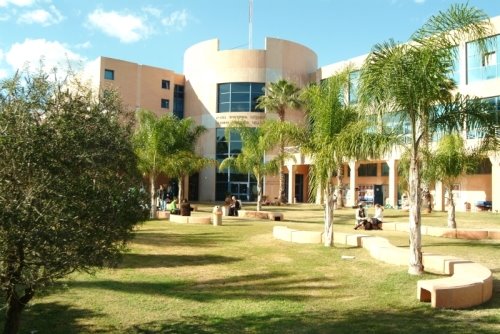 Netanya Academic College
School of Art and Multimedia
Learning at the Intersections of Art, Science, Technology, and Culture
I am negotiating with Israel’s Council of Higher Education for approval to establish a new fully accredited School of Art and Multimedia at Netanya College. I will be Dean of the School when it opens next year.
The New School
The School of Art and Multimedia will offer B.A. and M.F.A. programs in which students creatively redefine art at the interdisciplinary interface where new technologies and scientific inquiry shape cultural values of a Jewish state in an era of globalization. The program will couple theoretical studies with studio practice using new media to make artworks that create a lively dialogue between artist and society. It will prepare artists and designers to contribute imaginatively to Israeli and global culture and to develop innovative uses of digital imaging and multimedia in a wide range of fields.
The College
Netanya College was founded in 1995 as the university of the Sharon region between Tel Aviv and Haifa and is Israel’s fastest growing institution of higher education. It offers degrees in computer science and mathematics, communications, behavioral sciences, law, business administration and banking to its 4,000 students. The College is creating new degree programs in art and multimedia design, industrial engineering and management, and Middle Eastern studies. Its Strategic Dialogue Center, co-chaired by former president of USSR, Mikhail Gorbachev, and Prince Hassan Bin Tallal of Jordan, develops practical applications of integrated academic techniques in dealing with conflict-ridden areas of the globe.
Educational Program
The conceptual basis for the Netanya program is based upon an analysis of BA, BFA, MA, and MFA programs in American art colleges and university art departments that have a range of cognate titles: digital art, digital media, art and technology, computer art, conceptual information arts, media arts, new media, new genres, electronic art, interactive media, intermedia, multimedia design, electronic imaging and digital multimedia, interdisciplinary computing and the arts, arts computation engineering, interactive telecommunications, science technology art, and others.
I presented an educational model based upon this analysis at the SIGGRAPH 2005 conference on computer graphics and interactive media in Los Angeles. I am developing it further based upon the concepts of the world's most prominent educators in new media arts who have contributed to my 2008 book, Educating Artists for the Future: Learning at the Intersections of Art, Science, Technology, and Culture, being published by Intellect Books/University of Chicago Press.
Creative Learning
The educational model for the new school integrates this research with a structure of creative learning derived from Jewish thought. It explores interrelationships between five realms leading from intentions, thoughts, and feelings to action:
1. Precognitive realm of consciousness / spirituality / intention.
2. Cognitive realm of insight / conceptualization / inquiry.
3. Affective realm of emotions / aesthetic experience / artistic expression.
4. Space-time realm of action with materials / technologies / media.
5. Space-time realm of action in local community / global culture / business and industry.

